The first Greenville adventure will be coming up next: Greenville Railroad Park.
Saturday, July 16, 2016
Greenville, PA - May 30, 2016
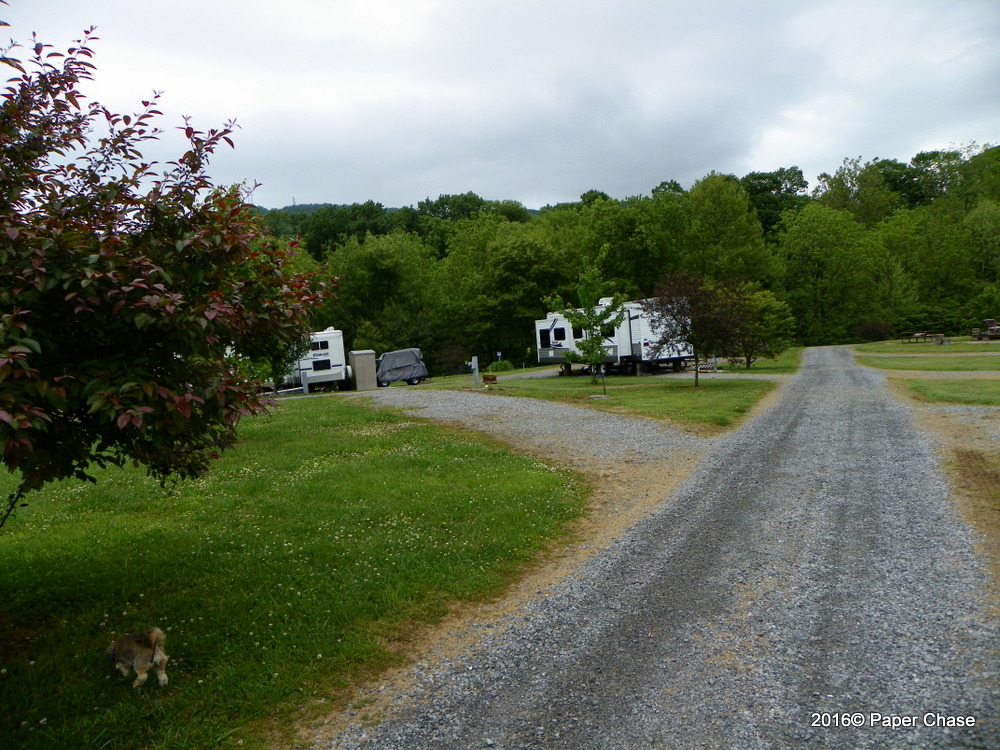
Arriving at Farma Family Campground in Greenville, PA during the afternoon, setting up the Bounder was accomplished quickly. Several adventures awaited. The photos below are a few of the unique seasonal or permanent structures in the campground.
Friday, July 15, 2016
Weston, WV Jackson's Mill Farmstead - May 2016
The day
we visited Jackson's Mill Farmstead we encountered intermittent rain showers, mostly while we were driving around in the car. As we walked up to The Mountain State General Store it began to sprinkle and we sat on a bench on their covered porch and watch the rain pepper down on the pond.
"Three generations of Jacksons operated mills at this site, originally settled by Col. Edward Jackson prior to 1800. Jackson’s Mill boasted saw and grist mills, a carpenter shop, blacksmith forge, quarters for twelve slaves, numerous barns/outbuildings, and a general store on 1500 acres of prime forest and pasture land.
Six year old Thomas Jackson and his four year old sister Laura came here as orphans in 1830. Thomas lived here until leaving for West Point in 1842.
Tom and Laura remained close throughout their lives until, like so many families, they found themselves on opposite side of the Civil War. Laura opened her house in Beverley, WV to Union troops as a hospital. Thomas joined the Confederacy and became immortalized as “Stonewall” at the First Battle of Bull Run.
Over the years, the Jackson farmstead was divided and passed through several hands. In 1921 the remaining property was deeded to the State of West Virginia to be used as a youth camp and entrusted to the Extension Service of West Virginia University. WVU Jackson’s Mill was developed and became the nation’s first state 4-H camp.
Today, all that remains of the original Jackson’s Mill settlement are the grist mill and the Jackson family cemetery. The other structures as well as the slave cemetery have been lost to the ages."
Wednesday, July 13, 2016
Weston, WV Trans-Allegheny Lunatic Asylum - May 2016
Our very interesting tour of the Trans-Allegheny Lunatic Asylum.
"Formerly known as the Weston State Hospital, this West Virginia facility served as a sanctuary for the mentally ill in the mid-1800’s. The history of the building holds fascinating stories of Civil War raids, a gold robbery, the "curative" effects of architecture, and the efforts of determined individuals to help better the lives of the mentally ill.
The Trans-Allegheny Lunatic Asylum, constructed between 1858
and 1881, is the largest hand-cut stone masonry building in North America, and
is purportedly the second largest in the world, next to the Kremlin. It was
designed by the renowned architect Richard Andrews following the Kirkbride
plan, which called for long rambling wings arranged in a staggered formation,
assuring that each of the connecting structures received an abundance of
therapeutic sunlight and fresh air. The original hospital, designed to house
250 souls, was open to patients in 1864 and reached its peak in the 1950's with
2,400 patients in overcrowded and generally poor conditions. Changes in the
treatment of mental illness and the physical deterioration of the facility forced
its closure in 1994 inflicting a devastating effect on the local economy, from
which it has yet to recover."
"Despite being designated
as a National Historic Landmark in 1990, the hospital has deteriorated to the
point where its very survival is threatened. The entire facility and 300 acres
were privately purchased in August of 2007 and renamed Trans-Allegheny Lunatic
Asylum (TALA) from The Weston State Hospital. With the aid of government
grants, private donations, fundraising events, and a team of dedicated local
volunteers, we are committed to restoring the TALA to its former grandeur, thus
reviving the local economy and preserving an important piece of American
history."
The picture above is not the area most in disrepair. In much of the building the plaster is falling down and there is much damage due to age and neglect. We were only able to tour a part of first floor of the largest building. There are many out buildings and some have been demolished. They are open for walk in tours Tuesday through Sunday. Special tours such as Photographic, Architectural, Civil War and Ghost are on a scheduled basis.
Next: A trip to Jackson's Mill Farmstead
Weston, WV The Museum of American Glass - May 2016
We enjoyed our time at The Museum of American Glass in Weston, West Virginia
"Imagine a museum dedicated to the region and nation's rich glass heritage. A place where examples of thousands of products can be viewed and compared and where the stories of people and processes come to life! The MAGWV provides this and much, much more.
The Museum of American Glass in West Virginia was established in Weston, West Virginia, in 1993 as a non-profit organization with a goal to discover, publish and preserve whatever may relate to the glass industry in West Virginia, the United States of America or where ever else glass has been manufactured." http://www.magwv.com/index.html
Coming up:
Trans-Allegheny Lunatic Asylum and Jackson's Mill Farmstead.
Thursday, July 7, 2016
Weston, West Virginia - May 19, 2016
We arrived and parked in Lewis County Park after another trip through the mountains. The front of the Bounder faced the park's tennis courts. The soccer fields are busy in the early evening. The swimming pool opened before Memorial Day and the picnic shelters got a workout. It is a great park for the county, however the rv parking is definitely an afterthought.
Due to the tennis court fence and a light pole in front of us, no other rv could get into any of the spaces outside our patio. The best part of getting into the park was the drive which slanted straight downhill. (There is a gated back way out of the park on a horridly rutted path, which we took really slowly, when we left. Thank you Tracy for providing the key to open the gate.)
We spent sometime in Clarksburg, WV just north of Weston. Clarksburg is the birthplace of Stonewall Jackson.
The space next to us on the driver's side has a sign on a light post the reads "Camper Hookups" There are electrical, water and sewer hookups below the sign, but in the center of the space is a tree staked in place. There isn't any way a "camper" could utilize this space.
Due to the tennis court fence and a light pole in front of us, no other rv could get into any of the spaces outside our patio. The best part of getting into the park was the drive which slanted straight downhill. (There is a gated back way out of the park on a horridly rutted path, which we took really slowly, when we left. Thank you Tracy for providing the key to open the gate.)
We spent sometime in Clarksburg, WV just north of Weston. Clarksburg is the birthplace of Stonewall Jackson.
The next adventure was a visit to The West Virginia Museum of American Glass in Weston WV.
Friday, July 1, 2016
Max Meadows & Wytheville, Virginia - May 12, 2016
After the trip through the mountains, we settled in a valley at Pioneer Village Campground close to Max Meadows, VA.
Views of Pioneer Village Campground showing the hills in the background that we enjoyed from both inside and out of the Bounder.
Took a day trip up in the Southwest Virginia Blue Ridge Mountains along the Big Walker Mountain National Forest Scenic Byway. This 16-mile byway showcases beautiful mountain scenery. Along the way, we stopped at Big Walker Lookout & BW Country Store and did not climb the 100-foot tower. This byway travels through the Jefferson National Forest. We continued down the mountain toward Wytheville and followed the path of Toland’s Raid as part of the Virginia’s Civil War Trails.
Unfortunately, we spent a considerable amount of time during this stay, at Bob Huff Chevrolet in Wytheville to have a new brake booster installed on the car. Some of the expense was covered under warranty. The dealer had a car take us back to Pioneer Village and picked us up when our car was ready. One of the days, when we were there, they invited us to a buffet lunch they were having at the dealership for their employees. Nice people....
After a one week stay, we headed through the mountains toward Weston, WV. Continuing north along I-77 and encountered the second tunnel. The "Big Walker Mountain Tunnel" a 4,229 foot tunnel under the Virginia/West Virginia State Line. Once again, I was driving. We took a shortcut on US Highway 19 from I-77 to I-79 and continued northeast to Lewis County Park in Weston WV.
Subscribe to:
Posts (Atom)